THE HISTORY OF THE BROTHERHOOD OF ST. CHRISTOPHER
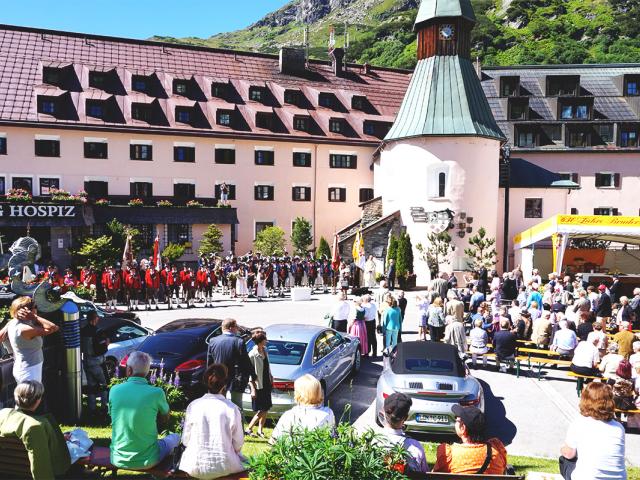
In 1386, the “Arlberg Hospice” and its chapel were built by Heinrich, a foundling from Kempten. During an audience with Duke Leopold III of Austria—while the duke was riding across the Arlberg—Heinrich Findelkind was granted a plot of land at the summit of the pass in 1385—where the hospice still stands today—and built the first inn there in 1386. In 1393, Pope Boniface IX granted him the right to build a chapel. Already during that first winter, Heinrich and his assistant, Ulrich Mossek from St. Gallen, were able to save seven people from certain death in the snow. Every evening, especially in bad weather, they set out to search for lost travelers. These people were then brought to the hospice and given food and drink until they had regained their strength. During the summer months, Heinrich and his helpers traveled throughout Europe with the brotherhood’s collection books to raise money for the hospice and its upkeep.
Since that time, the brotherhood has experienced an eventful history spanning six centuries. The name Heinrich Findelkind has been lost to history since 1430. During the Thirty Years’ War, from 1618 to 1648, the brotherhood reached the height of its influence. After nearly 400 years (1386 to 1783), under Emperor Joseph II, son of Maria Theresa, the brotherhood was secularized and its main register was transferred to the State Archives in Vienna. With the construction of the Arlberg Railway Tunnel in 1884, the hospice was left to fall into disrepair, as only the poorest—those who could not afford the train—continued to travel over the Arlberg. Carl Ganahl, Governor of Vorarlberg and great-grandfather of Arnold Ganahl, the future owner of the house, succeeded in persuading the Vorarlberg and Tyrolean state parliaments to have the hospice designated a historic landmark and to appoint a caretaker.
In the summer of 1955, Arnold Ganahl of Feldkirch, Gerda Werner’s father, purchased the old inn and began restoring it. Unfortunately, on the night of the Epiphany, January 6, 1957, an electrical short circuit caused the hospice and the chapel to burn to the ground. Arnold Ganahl, however, had the hospice rebuilt with its traditional steep roof, and by Christmas 1959, the building reopened as a first-class hotel, restored to its former glory.
In October 1961, Arnold Ganahl, together with 40 friends, reestablished the St. Christoph Brotherhood, and in January 1962, the reestablishment ceremony took place at the Arlberg Hospice. In 1964, Adolf and Gerda Werner took over the brotherhood, which at that time had 126 members. By 1977, the brotherhood had slowly grown to 1,000 members. It was only following tragic accidents during the construction of the Arlberg Road Tunnel (1974–1978) that the Brotherhood began to grow rapidly. Starting in 1977, the Brotherhood supported the half-orphans of the 18 miners who lost their lives in accidents during the construction of the Arlberg Tunnel. Today, the Brotherhood has nearly 23,000 members and primarily helps families with children who have fallen on hard times through no fault of their own—in Austria, Germany, England, Switzerland, and South Tyrol. Its annual budget now amounts to approximately €800,000.
The St. Christoph Brotherhood is led by Helmut Mall and supported by the Brotherhood Council, which consists of 18 members. Twice a year, the council members meet for a council meeting. The treasurer, together with the members of the “Social and Charitable Committee,” oversees the distribution of donations. From its inception to the present day, the Brotherhood has distributed more than 19 million euros to families in need, free of administrative fees and expenses. Join us in helping others!
Sacred Art in the Brotherhood Chapel:
Statue of Saint Christopher:
A 380-centimeter-tall wooden sculpture. Created in 1959 by the sculptor Pepi Rifesser of St. Ulrich in the Grödental Valley (South Tyrol).
Three figurative stained-glass windows by academic painter Martin Häusle, Feldkirch, 1961:
Left – The Church on its Pilgrimage and the Church in its Fullness
Center – The Assumption of Mary – Patroness of the Church
Right – In Memory of Heinrich Findelkind, Founder of the Hostel and Father of the Brotherhood of St. Christopher.
Suspended cross above the altar:
Body embossed in copper. Designed and crafted in 1961 by silversmith Johann Griesser of Innsbruck.
Tabernacle:
“The Feeding of the 5,000—‘Give them something to eat.’” (Matthew 14:17) Sculptor Ulrich Henn from Leidersfeld, Eifel—donated by the Arthur Schneider family, 1986.
Ambo:
“The Feeding of the 5,000—‘Give them something to eat.’” (Matthew 14:17) Sculptor Ulrich Henn from Leidersfeld, Eifel—donated by the Arthur Schneider family, 1986.
Image of the Virgin Mary:
Nazarene style, oil on canvas, by Fidelius Bentele, 1872, donated by the Heinrich Heineck family of Haslach at the Grüntensee.
Way of the Cross:
Oil on canvas, late 18th century, southern Germany, artist unknown.
Sandstone Coat of Arms:
Coat of arms of Heinrich Findelkind and 2. Coat of arms of the Brotherhood
Niche containing the book of the deceased brothers and sisters:
“The living remember the dead.” In the chapel foyer
Wooden sculptures in the stairwell:
By sculptor Emil Kostner from Santa Cristina in Val Gardena, South Tyrol. St. Urban—patron saint of innkeepers—and St. Catherine, the chapel’s second patron saint.
Saint Christopher
You are not only there for travelers and wanderers
You are also always there for people
Who are searching for the meaning of life
You are also always there for people
Who seek God in their lives
You have found the meaning of life
To serve God and humanity
You have also found God and eternal love
Which loves and sustains humanity!
We pray to you:
Be a walking stick and a staff for seekers on their journey.